
Lately, I’ve been confronted in varying circumstances by the natural human drive for laziness, both in myself and in humanity as a whole. I view laziness not as a personality flaw but as a state of being—one hardcoded into our DNA to preserve our energy for things that really matter. As one of my mentors has told me many times…
The best programmers are lazy.
… Which I believe to be true (when understood correctly). Lazy programmers learn new ways to reduce their workload. Lazy programmers automate their tasks. Lazy programmers take the simplest path to solve a problem, making their solutions easier to understand for unfortunate future interns.
I hope this drives home my point that laziness can be useful. That being said, I am tired of talking about software engineering. I want to talk about what we do when we’re not being paid, because I think that says a lot more about who we are as people.
In a world that steals as much time and attention from us as it can, it can feel like we need to maximize every waking moment. Naturally, we seek conveniences to accomplish this. Meal replacement drinks to reduce the time we spend eating or cooking, automatic lightswitches so we don’t need to stand up to turn on and off the lights, or AI assistants to create images so we don’t need to wait for an artist.
I don’t think these things are necessarily bad. Many are useful. However, I believe that seeking convenience in every aspect of life kills the joy of effort.
AI and authentic connection
I’m talking about AI now. If you’re tired of hearing about it, skip to the third section.
Have you ever asked a chatbot a question you’d normally ask a friend, coworker, or parent? I know I have. Maybe you didn’t want to trouble them or needed a quick answer. Think of the opportunity for connection that was missed by making that choice. Instead of learning from someone you trust and respect, you got your answer from the language model—one that has consumed likely the entire internet and more, yes, but one that doesn’t truly know anything.
Brief aside: My full thoughts regarding AI could fill another blog post of equal length (and likely will someday), so I’m going to keep it short here and just say—I believe that AI should be used incredibly thoughtfully, carefully, as a last resort, and its output should be clearly labeled.
Think to a time when someone else has asked for your advice or knowledge. Isn’t that moment an honor, and one in which you feel obligated to give them the best information you possibly can? Maybe you even spent the rest of the day thinking more on the topic and updated them with better answers. When you ask a chatbot instead, you deprive someone you care about of that experience, and yourself of their human wisdom.
Yes, let’s kill art, great idea!
Art is, by its nature, inconvenient to make. It exists for an artist to share what they may be otherwise incapable of communicating, or just as an aesthetic practice. For the artist, the purpose is the pain—not in the cliché starving artist way, but in the pain of inconvenience. When one makes “art” with AI, they bypass that process to have an instant product. There is no human intent, you just tell the AI what you want and it makes something approximating it. Sometimes you have to change your prompt—this is the only effort required. They are more akin to a patron without money than to an artist.
This is why Spotify’s embrace of AI music is both tragic and predictable. As a company, they have been the driving force for paying musicians literally nothing in many cases, normalizing the unconscious expectation that art should be free. (I believe both that everyone should have access to art and that artists should be paid well, but that is yet another blog post.) AI music is perfect for Spotify, as they have to pay no one. AI “musicians” are happy with getting pennies for their complete lack of effort (and they should be given pennies less) and Spotify continues to, finally, make a little money.
This isn’t just a few people taking advantage of Spotify and a few dumb suckers listening to nothing-music. Wildly enough, the top Christian artist near the end of 2025 was AI generated. This isn’t even against the terms of service, since it’s not trying to impersonate anyone.
What does this have to do with convenience? As a listener, Spotify makes it incredibly easy to consume music. Access to art, as I mentioned, is a great thing. However, I think there is something lost in the way that Spotify presents music. Instead of the experience of sorting through random artists you’ve never heard of in your local record store, Spotify does what huge corporations do best and commodifies the experience. It watches you incredibly carefully and makes determinations about what you like, feeding that to an algorithm that spits out music it thinks you’ll like—and it is incredibly good at doing this. That is one of the main selling points of Spotify. However, this keeps you listening to the same types of music. Discovering anything outside of your comfort zone is difficult, as your “Discover Weekly” playlist is full of music similar to what you already listen to, and often music that has hit a certain level of success with Spotify already (usually by getting placed on Spotify official playlists). For years, I found myself not branching outside of music I already enjoyed, and in retrospect it is because I was caught in that cycle.
Contrast this to the experience of opening up Bandcamp. You get a list of music that people all over the world are buying at that moment, completely uncurated to what you like—because Bandcamp has no earthly idea what you like. You open up the search bar and Bandcamp practically screams at you, “What are you gonna find next, buddy? Avant-garde polka metal? For sure, I got some right here.” I find it particularly fun to search for a weird combination of terms. For example, today I put in “neoclassical” and filtered to folk, which is how I discovered the genre of “darkfolk”. I love it. The inconvenience catalyzed a new experience. (I’m sure these artists are on Spotify, but if you have never listened to anything like them, you probably would never have found them.)
If you haven’t started a media server yet, you should. Start buying your music. It is more fun.
Minecraft’s cycle of convenience
When you start a fresh Minecraft world, you have begun your inevitable march toward boredom. Everyone who’s played Minecraft for more than a couple years knows how it happens. You punch a tree until you have wood, make a wood pickaxe, get stone, and it has started. You slowly build up the systems around you that make the game easier and easier until you’re bored. Eventually you’ve got more resources than you could dream of using, and you stop playing for a while—until you pick the game up later, start a new world and begin the cycle again, convenience-ing yourself back to boredom.
I think that is fine, good, and fun to do. I also think it’s a great allegory for real life. It is incredibly easy to convenience yourself out of the fun of doing the things you love, without ever realizing that the pain is the purpose. You should convenience yourself out of the fun of Minecraft, but you should not do the same with your hobbies.
The simple ritual of effort
A few days ago, my girlfriend (Corrina) and I were looking at the website for a company that makes home automation products. One of the things they sell is a water sensor which can be used to automatically water your plants. When Corrina pointed it out, I said “why even have a plant at that point?” That began my thought process. I feel that the point of having plants (in addition to beautifying your environment) is the meditative ritual of watering them—the quiet moments of reflection where you’re forced to focus only on the well-being of this little piece of vegetation that can’t say “thank you” in any way beyond flourishing under your care, but that you feel deeply emotionally attached to (or at least I feel that way and I’m not much of a green thumb). You could easily automate that away, but I encourage you not to.
I believe, like many, that doing things that are hard are worth doing simply for the effort that is required. However, I believe that doing things that are hard that could be easy in a different circumstance—if you were someone else, had different tools, or did it another way—should be considered a simple ritual; a ritual that enriches your life, strengthens your body and mind, and is worth dedicating time to. Simply knowing that there is an easier way to do something and rejecting it for the experience of doing it differently is invaluable.
I think people may understand this intuitively. Videos often go viral online for simply doing things in a way that is harder. For example, to bring it back to Minecraft, 1ThingEveryday is beating Minecraft by only doing a single thing each day. They load up their save, fire an arrow, click “Save and Quit to Title”, and that is it for the day. This simple ritual, while not much effort per day, is much more difficult in summation. All it takes is one thing going wrong and they’re stuck for several days off-track. On day 522, they beat the game, with comments like “WE DID IT!!!!!!!” and “I’m devastated it’s over” receiving thousands of likes. Thousands of people celebrating doing something the “wrong” way.
In closing
I love Calvin and Hobbes. I find myself identifying more and more with Calvin’s dad, so I must be getting older. There are many strips I think of often, but this one comes to mind right now:
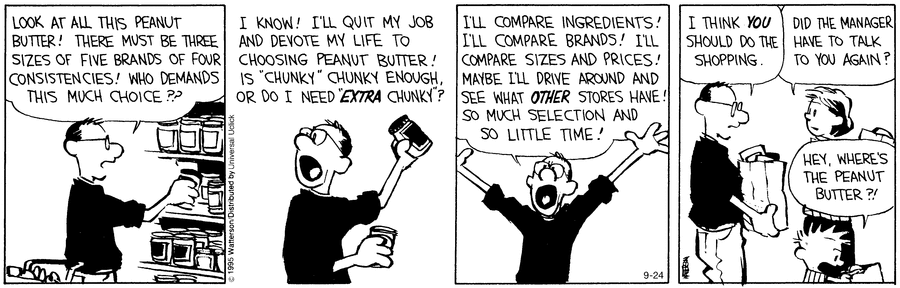
The irony of building a world around convenience is that we have made it deeply inconvenient to be human. We built global supply chains to provide food across the US, but in doing so made the locations where we actually get the food nearly impossible to walk to (whether that be because of dangerous roads or simple distance) and designed to take as much of our money as possible. We put in self-checkouts so we don’t need to be bothered to connect with our neighbor who works the counter.
I don’t want to sound like I’m chastizing people for enjoying the amenities of modern life or like I feel that I’m above them. I just want you to think about what it affects, as I’ve recently begun to. Consider the simple ritual of effort. Choose to enrich your life.
Water your own flowers. In a world built on convenience, it is a tiny act of rebellion.